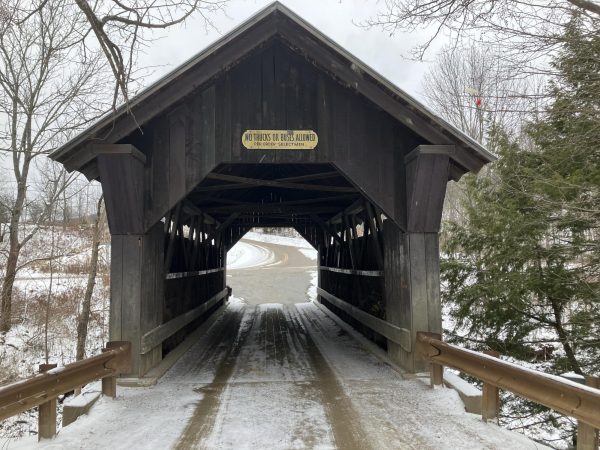
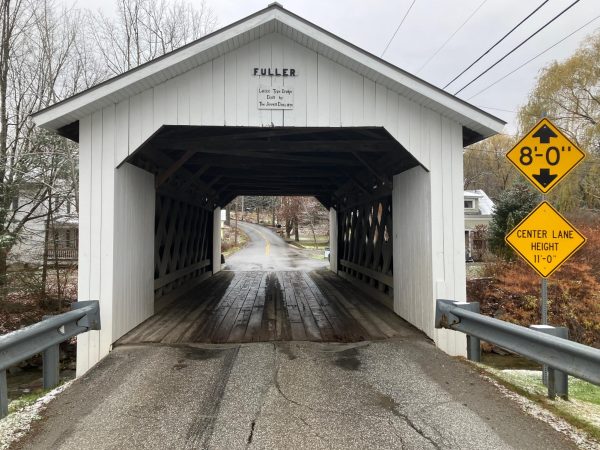
Vermont is known for its covered bridges, with some 100 scattered across the state. While Vermont’s number of covered bridges has decreased over the years, it still boasts the most per Capita of any state in the nation. The “Covered Bridge Capital” of Vermont can be found right here in Franklin County–Montgomery has the most covered bridges of any municipality in the Green Mountain State, with six of them in its town lines.
The oldest covered bridge in Vermont spans Otter Creek in Middlebury, and is called Pulp Mill Bridge. This bridge is also one of the oldest covered bridges in the country, having been constructed in 1820. It is one of the few remaining two-lane covered bridges in the United States, and is still used today to bring traffic across Seymour Street between Middlebury and Weybridge.
Many other covered bridges have a storied history, such as Gold Brook Covered Bridge (also known as “Emily’s Bridge”). Legend has it that sometime in the 19th century, a young woman named Emily and her lover planned to meet on this bridge. Emily showed up. Her lover did not. It is said that Emily became so overcome with despair that she hung herself here. Today, Emily’s ghost is rumored to still have a lurking presence on this bridge, scratching vehicles that drive over it or skulking in the shadows. The Gold Brook Covered Bridge is located in Stowe and is open to vehicular use.
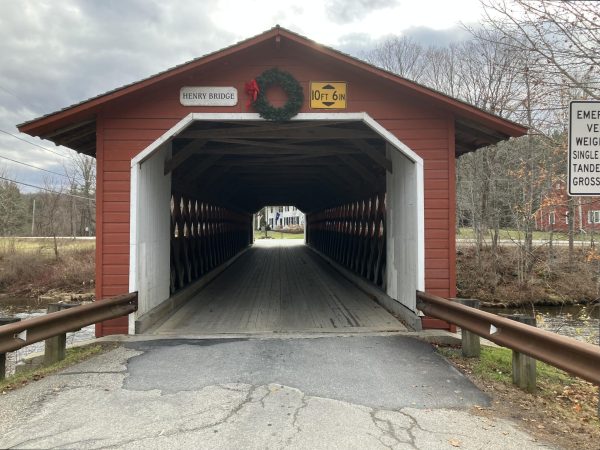
Some of the state’s most photographed covered bridges lie in Woodstock, home to the Taftsville Covered Bridge and Middle Covered Bridge. Both bridges cross the Ottauqechee River, and while Middle Covered Bridge is located in the heart of the village, Taftsville Covered Bridge can be found on Woodstock’s outskirts, near the Hartland town line. Another distinction between the two is their colors: the Taftsville bridge is painted a sharp red, while Middle stays true to its rustic color palette, which contrasts beautifully against the blazing hues of the leaves around it.
For a covered bridge not accessible to cars but only to pedestrians, visit Shelburne Museum’s 19th-century covered bridge, which formerly spanned the Lamoille River in Cambridge. This bridge once served as the gateway to Shelburne Museum, welcoming in cars, but is now gated off to traffic in favor of the museum’s new entrance.
In sum, each of Vermont’s covered bridges tells a story. Stories of people connected to them, and of origins dating back to the early 19th century.