Gerald Stoner teaches numerous classes here at BFA, including Photography, Painting, Sculpture, Art I and Art II. Outside of the classroom, he owns and operates a sculpture business called Gerald K Stoner Sculpture at Underhill Ironworks. In this interview with The Mercury, Mr. Stoner discusses the sculpture-making process and what led him down this career path.
Q: What initially drew you to sculpting?
A: My journey with sculpture began with Don Osborn, my first sculpture professor at SUNY Plattsburgh. I was enrolled in an introductory sculpture class when Don, a well-respected and nationally recognized artist in his own right, pulled me out of that class and placed me into Sculpture II in the middle of the semester. He was a welder, and during my junior year, I started learning how to properly weld. At the time, my emphasis was in film photography, but suddenly I found myself creating all of these robust steel sculptures. Don gave me the confidence and inspiration to lean into sculpture, although I continued with photography, eventually graduating with a double major in sculpture and photography. I haven’t stopped making sculptures since. When my days at SUNY Plattsburgh ended, I entered graduate school where steel is plentiful, and earned my MFA in sculpture from Northern Illinois University.
Q: What ideas or influences inspire your sculptures?
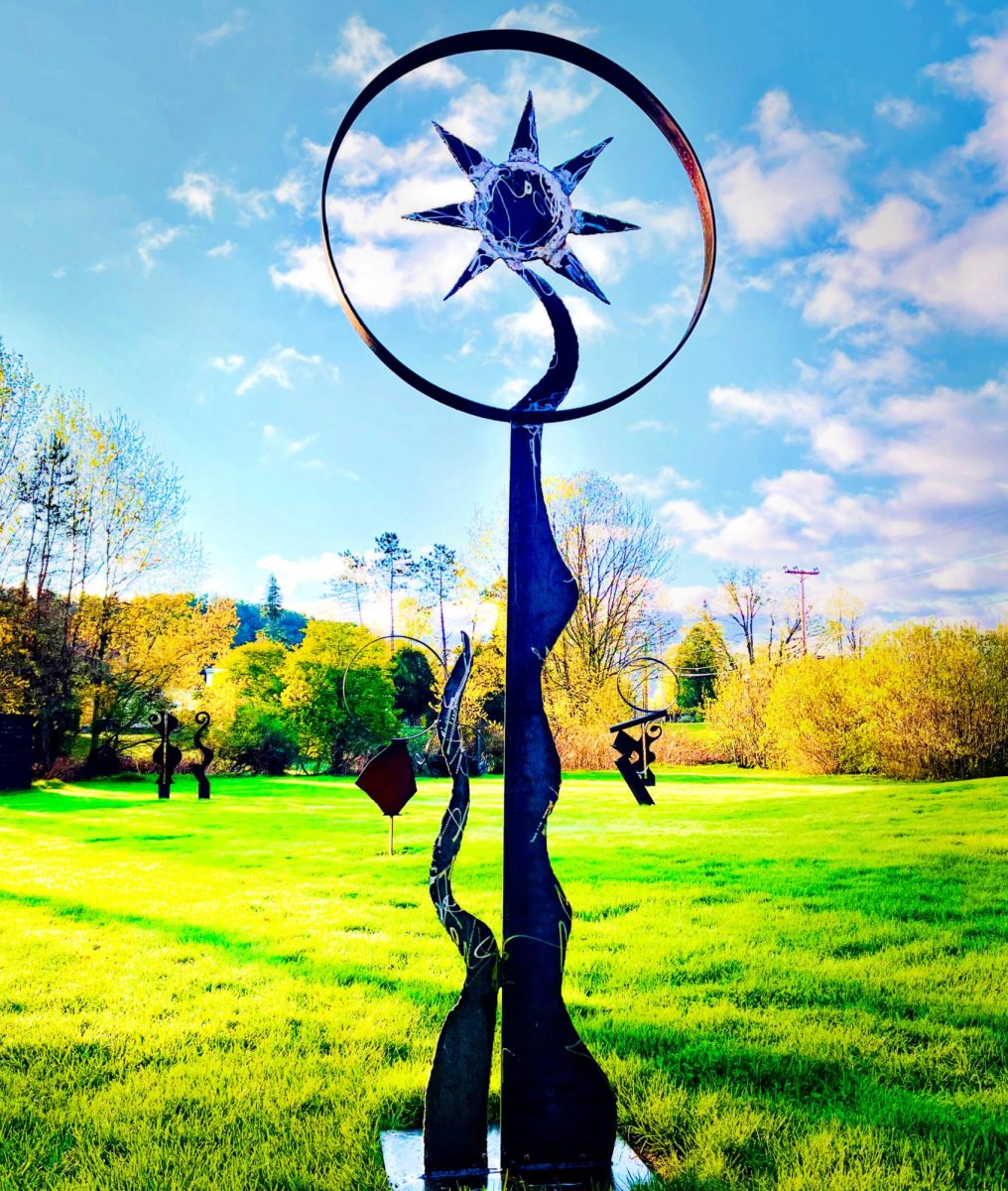
A: I find inspiration in nature, recycled and repurposed materials, and steel itself. My focus is on taking materials typically used for construction purposes and presenting them in a completely different light.
Q: How do you use recycled materials to create sculptures?
A: The large steel circles found in many of my sculptures come from old wheels, hosting a history with Vermont farms. I also use a lot of repurposed material from Queen City Steel in Burlington. Those are the main elements I work with, but I occasionally incorporate old chains and antique cogs from garden equipment as well.
Q: What is the hardest part of making a sculpture?
A: Vision and shape are what one first notices in sculpture. You have to step back and appreciate the work and nuance that goes into actually welding the materials to connect strength to eliminate noticeable flaws, or slag. When I first started making sculptures, the hardest part was learning how to use the tools. I had to learn how to use an oxy-acetylene torch and how to weld. Every sculpture has moments where you’re trying to resolve what you want to say through the piece, but I wouldn’t necessarily call it difficult because I enjoy the process. Sometimes the most challenging part is simply the physicality of moving heavy sculptures.
Q: Do you have a personal favorite sculpture you have made?
A: I have a few sculptures that I created as an undergraduate student in Plattsburgh and a graduate student at Northern Illinois, and I still have them today. Those are pieces I will never sell. Plus a few sculptures that are for my family.
Q: What sculptures are you working on now?
A: Recently, I’ve been working on sun sculptures. I’ve completed two of those, along with two abstract sculptures that incorporate antique and repurposed wheels. I’ve also created fish and bird sculptures. Series are constantly evolving, offering a variety to speak to many.
Q: Can you talk about your open studio?
A: My open studio takes place Memorial Day Weekend, May 23 and 24, from 10 a.m. to 5 p.m. It’s part of an event where artists from all around Vermont open their studios to the public so visitors can experience their artwork firsthand. I’m fortunate to live in Underhill, where many other artists also participate. We typically welcome visitors from all over New England, Pennsylvania and New York, and usually see around 100–150 people over the course of the weekend.
Q: Where can some of your sculptures be found?
A: My sculptures can be found at businesses and public spaces throughout Vermont, including locations in Manchester and Johnson. In St. Albans, there are two sculptures near The Connector and another at Reid Commons, a senior living facility built last year. There are also numerous sculptures at Lemon Fair Sculpture in Shoreham. In addition, my work is included in private collections throughout New England, Pennsylvania, Ohio, New York, Washington DC, and South Carolina.
Q: Can you talk about the process of making sculptures?
A: Sometimes I begin with sketches or drawings, but the process is also shaped by the materials I have collected. From there, I start creating. While I may begin with an original drawing, the sculpture often changes significantly during the process. The work evolves intuitively as I sculpt in the studio. Most of my time is spent cutting, welding, and grinding steel.
Q: What advice would you give to aspiring young artists?
A: If you’re passionate about art, spend as much time creating as you possibly can. The more time you dedicate to it, the more you improve. It’s also important to promote your work and find ways to get it out into the world. Create an Instagram account, a Facebook page, and a website. Enter as many juried exhibitions as possible, and if you don’t get accepted into one, keep applying to others. You won’t get into every show, but each experience helps build your resume and career. Spend as much time in the studio as you can because your professors will notice your dedication, and that can lead to strong letters of recommendation. Ultimately, success comes down to commitment and passion.