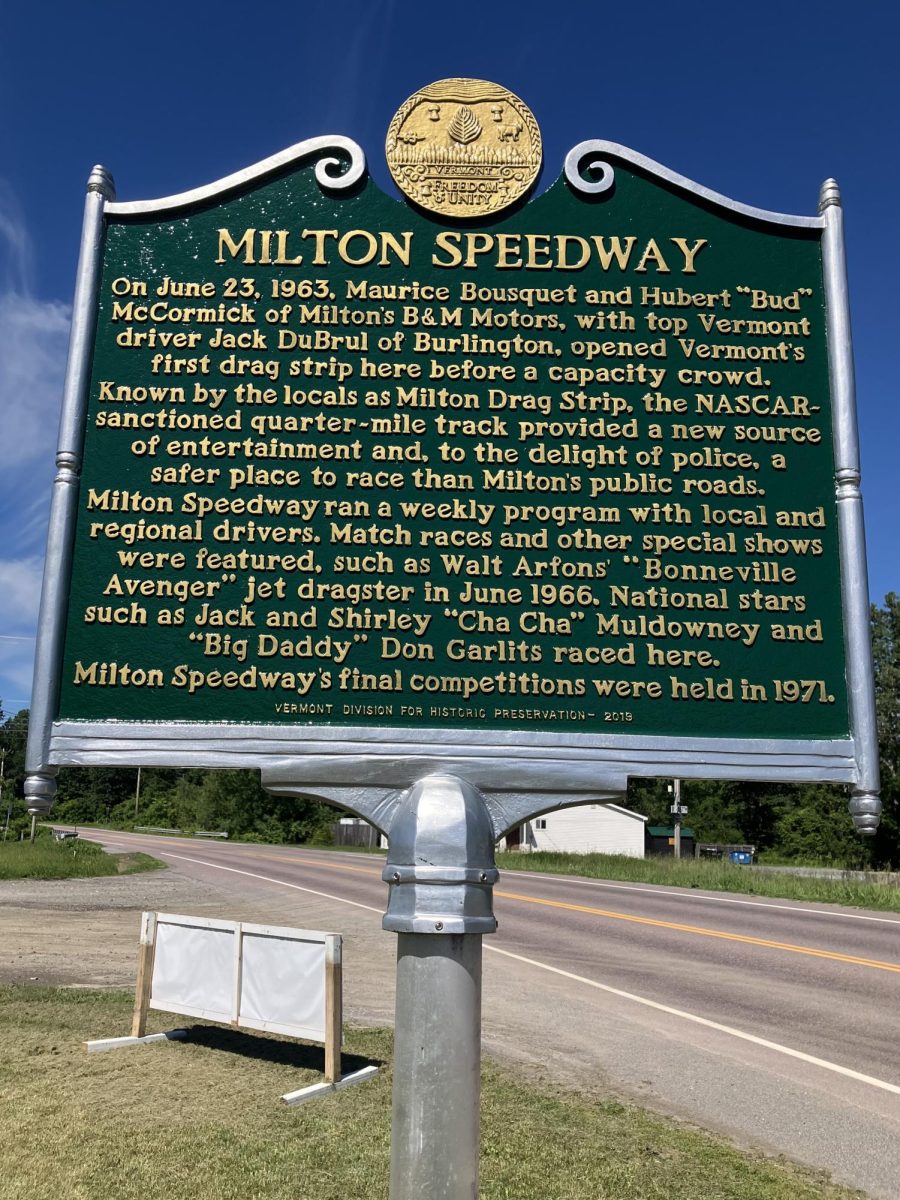
The Mercury recently had the opportunity to interview Laura Trieschmann, who has served as Vermont’s State Historic Preservation Officer since 2013, responsible for managing Vermont’s historical markers. She holds a graduate degree in historic preservation from the University of Pennsylvania and, prior to coming to Vermont, she worked as a preservation consultant in Washington D.C. Below, she discusses the process of erecting each historic marker as well as little-known facts that make Vermont such a special state.
Q: How did the historic marker program begin in Vermont?
- It began in 1947 as a pilot program initiated by the Vermont General Assembly. They wanted 75 markers placed around the state at the major historic landmarks to serve as tools for tourism. The very large signs were like advertisements and often included hours of operations. One of the original ones can still be seen at Rokeby in Ferrisburgh, which shows the incorrect hours the museum is open. The markers proved so successful that the program became permanent.
- We have used the same foundry since 1947. Sewah Studios in Ohio.
Q: How does a person or community nominate a location or event for a historic marker?
- Anyone can submit an application for a historic marker. All applications are welcome. If it is not done by a property owner or town, we get their permission.
Q: What criteria is used when deciding if something is historically significant enough for a marker?
- The commemorative topic must meet the criteria (see attached), which is site associated with an event, lives of significant persons, or embodies distinctive character of construction/architecture or work of a master. Markers cannot commemorate a living person, and the event should be 50 years or older, ensuring sufficient time has passed to understand and appreciate the significance. There have been exceptions to this rule of 50 years or older, depending on the significance of the topic.
- We need sufficient primary and supporting secondary documentation of the topic.
- These topics, ranging from triumphs to tragic, invisible histories, remind us that engaging with the past can be emotionally difficult yet necessary.
Q: What kind of research goes into writing the text on a marker?
- We need sufficient primary and secondary documentation so that we can double/triple check the facts and identify any other elements that should be noted on the marker. Typically, we get a detailed bibliography with copies of some of the primary documentation like community or family histories – things that are not easily accessible.
- When needed, we engage subject experts to help verify the facts and pull together the text.
Q: How do historians make sure that the information on a marker is accurate?
- This again goes to our verification of the facts using the internet (especially google books, library of congress, national archives, Vermont archives) and historical papers and books at historical societies and libraries and check with subject experts. We double/triple check the facts.
- The final text, once approved by the applicant, is presented to the Vermont Advisory Council on Historic Preservation for review and approval. They also do research and wordsmith. You are always welcome to attend their meetings, which are virtual. The March 19 meeting has markers for United Methodist Church in Winooski, General John Glover in Glover, Derby Veterans Park, and Clarendon Springs.
Q: Is it difficult to capture a historical event in a limited amount of space on a marker?
- Oh yes! The markers hold only 765 characters, which includes the title, subtitle, spaces, punctuations, and all words. It does not include “Vermont Division for Historic Preservation – 2026.” Applicants often share great related details to include on the markers but we edit to keep it down to facts. This way we can feed an immediate interest but spark a desire to learn more. Often we are continuing a story on the opposite side of a marker rather than having both sides say the same, this allows more of the history to be told. In several cases, a related but different story can be on the opposite side. This is the case for example with the Waubanakee Golf Course that is on one side and the Burlington Country Club on the other.
- I encourage applicants to write more than 765 and let me edit. That way I can get more of what is important to them on paper. This can mean 800 characters or five pages but digging in to identify what makes the topic worthy of commemoration is the fun part. What do we want people to know from this marker?
Q: Do you have a personal favorite marker, and if so, which one and why?
- Oh that is difficult because my favorites are usually the most recent ones I have worked on because I get to learn so much about Vermont and her heritage. I am super proud of a few like Vermont Equality for Same-Sex Couples in Montpelier, Dr. Laura Plantz in Putney, Norman Rockwell in Arlington, Revolutionary War Patriots in Burlington, and Ralph Waldo Ellison in Fayston. Two new ones not yet up that I am proud of are Leonard Lord in Swanton and Ann Story in Salisbury. I like the ones that teach people something they never knew, especially when they have driving past that spot 100s of times. Same-Sex Couples tells the story of major legislations and how Vermont was the first to recognize same-sex couples, and it was a recent past story that mattered to many people. Dr. Plantz was Vermont’s first female medical practitioner, and we discovered this by accident as her former home was being renovated for low-income housing. Norman Rockwell is a national figure but belonged to Vermont, and many of his neighbors were used as models for his art. The dedication attracted about 300 people! The Revolutionary War Patriots marker was done in collaboration with the Daughters of the American Revolution, and their historians really verified the facts. The marker has the names of the ancestors of the members of the Chittenden Chapter, so there was a strong connection. The Ralph Waldo Ellison marker, which took years to get approved, represents an award-wining novel about African Americans that was started in Vermont. The family who invited Ellison to vacation in Vermont still own the property. Leonard Lord was the first Vermonter killed in World War I and Ann Story risked her life and her children’s lives supporting the Green Mountain Boys during the Revolution by acting as a spy. These are amazing Vermonters.
- For me, it’s the personal connections to a family member, community residents, or activity that makes me proud. Even the difficult tragic stories move me.
- My goal is to have markers in all towns and villages. We have 151 towns/villages included now.
Q: What do you hope people will feel or learn when they read one of Vermont’s historic markers?
- There are so many stories to tell about Vermont and her people. I hope the markers educate people, remind them of our history, inspire them, and make them proud of our Brave Little State. The foundry calls the markers “History on a Stick.” Teaching people about their places and neighbors is our goal as we celebrate and commemorate Vermont. All history matters and this is a great way to share it.